
HuffPost. April 2026.
Industry leaders, farmers and advocates explain what “pasture-raised” truly delivers — and where the label still falls short.
In a growing industry centered on sustainable, healthy and humane food, “pasture-raised” chicken has become the premium badge in grocery stores, often costing 30% to 100% more than conventional poultry.
Yet most shoppers don’t actually know what they’re paying for — or whether it is truly better than non-GMO, organic or free-range options. As food costs rise and health awareness increases, consumers are seeking to better understand marketing labels and make informed choices.
What is pasture-raised chicken?
Simply put, pasture-raised chickens may be raised indoors or outdoors but must have access to pasture. A true pasture-raised poultry farm uses floorless coops with predator protection, allowing birds to spend most of their time grazing and foraging on clean pasture. The coops are often moved regularly to fresh ground to replicate a more natural lifestyle.
True pasture-raised chicken tends to be smaller, with deeper-colored meat and a richer flavor. It’s also perceived as more nutritionally dense. Some studies and community lab analyses suggest that pasture-raised chicken can have higher omega-3 fatty acid levels and a more favorable omega-6:omega-3 ratio than conventional chicken, though the magnitude varies widely depending on diet, forage intake, breed, and cut.
How is it regulated?
In reality, the United States Department of Agriculture (USDA) has historically offered loose guidance for what qualifies as pasture-raised. It wasn’t until 2024 that the USDA updated its definition, stating that “pasture-raised birds must spend the majority of their lives on physical pasture to carry the label.” That clarification came after nearly a decade of industry petitions and debate, prompted in part by concerns about greenwashing within the pasture-raised sector. (The updated definition stemmed from a petition submitted by Pasturebird, a brand under Perdue Farms.) However, the ruling is not being enforced by the USDA.
It is important to note that organic, non-GMO, antibiotic-free, cage-free and pasture-raised are not interchangeable terms. Organic refers to how the chicken is fed and raised under USDA standards — including organic feed, no antibiotics and outdoor access. Non-GMO applies only to the feed’s genetics. Antibiotic-free means the bird was never given antibiotics. Cage-free means it was not confined to cages but may still have been raised indoors. Pasture-raised means the chicken spent the majority of its life outdoors on pasture.
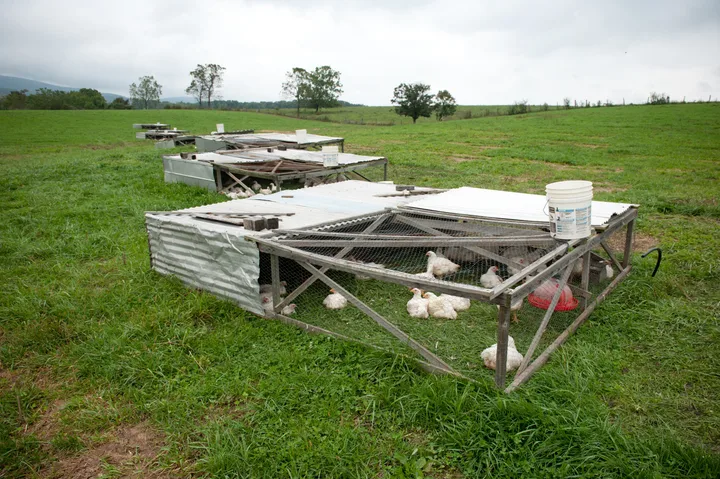
Perdue’s Pasturebird brand, based in Butler, Georgia, uses a rotational grazing system with mobile coops that move daily, allowing birds constant access to fresh pasture while regenerating soil health and reducing environmental impact. “While the regulatory definition is a step in the right direction, enforcement is still not happening,” Pasturebird founder Paul Greive told HuffPost, explaining that while many other farms are not transparent, PastureBird utilizes live cameras that allow consumers to see how the birds are raised. He argues that many other farms call themselves pasture-raised even when birds don’t spend the majority — or sometimes any — of their time on pasture. According to Greive, the word “access” is often used loosely to mislead consumers. Birds on true pasture farms should be active — hiding, roosting, perching, and foraging. “Having a doggy door alone is not enough,” he added.
Beyond outdoor living, pasture-raised farms commonly emphasize humane practices such as limiting flock size, providing nutrient-dense feed rather than just soy and corn, reducing the use of preventive medications, and regularly testing for and reporting antibiotic residues.
Regardless of an organic, free-range or pasture-raised label, “almost 99.9% of all birds raised for food in the United States come from genetically selected, fast-growing birds raised in industrial farms,” said Andrew deCoriolis, executive director of the nonprofit Farm Forward, which advocates for reforming animal agriculture. Over decades of selective breeding, modern broilers have been designed for rapid growth and confinement. “In other words, these are birds not designed to thrive on pasture. They were designed to live in climate-controlled barns, where they don’t have to walk more than a few feet to reach feed and water,” he explained.
deCoriolis favors forested farms such as Minnesota-based Tree Range Farms that raise slower-growing birds in silvopasture systems. In this model, chickens forage among trees for grasses, seeds and insects, benefiting from natural shade and protection. The regenerative approach supports soil health, diversifies farm income, encourages natural behavior, and reduces heat stress — a significant welfare issue in poultry production.
How can you actually ensure you’re buying real pasture-raised chicken?
One of the biggest challenges for consumers is the lack of transparent labeling. “Many certifying bodies are incentivized through membership dues and trade affiliations rather than strict standards,” deCoriolis said. “And agricultural research is often heavily influenced by meat industry funding.”
There are a few independent certifying bodies that consumers can trust. For example, A Greener World’s Animal Welfare Approved standards were developed by scientists, veterinarians and farmers, based on the understanding that high-welfare, pasture-based systems benefit animals, the environment, and public health. Executive director Emily Moose explained to HuffPost, “Since we aren’t financially dependent on certification fees, we’re able to write standards that are simultaneously practical and meaningful. Our auditors visit farms every 15 months to ensure standards are upheld, giving consumers confidence that their purchases have a positive impact.”
Websites such as GetRealChicken.com, hosted by the nonprofit American Pastured Poultry Producers Association, provide a trusted listing of local farmers raising pasture-raised chicken. deCoriolis strongly advises consumers to look for traditional breeds or slower-growing hybrid birds, which may mean buying directly from regenerative farms, visiting farmers’ markets, or asking questions at local grocery stores.
When shopping for pasture-raised products, Greive also encourages consumers to do their own research — talk to local farmers, review live farm feeds, or request farm visits. Resistance to transparency can be a red flag.
Ultimately, Americans say they want less cruelty in the meat industry, and some advocates argue the USDA should require stronger verification and enforcement. Perdue Farms chief commercial officer Todd Tillemans concludes, “For many consumers, pasture-raised signals higher animal care standards, transparency, and a closer connection to the farm. It expresses a belief that raising chickens on open pasture contributes to distinctive taste and overall quality. That production model requires more land, more labor, and more time, which carries a different cost structure.”
Pasture-raised chicken is more expensive. But when consumers weigh nutrition, flavor, animal welfare and environmental impact, many consider it a worthwhile value. In the end, the choice comes down to which standards align most closely with one’s personal priorities.