
Khabar Magazine. October 2026. Print cover story.
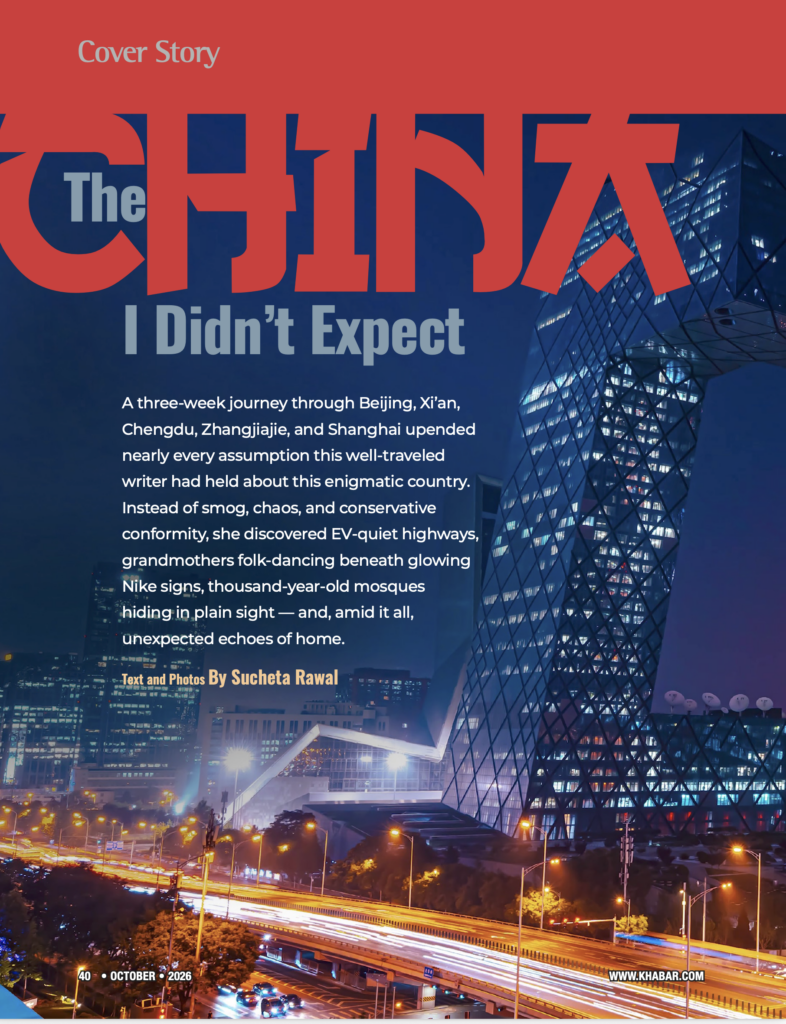
When I landed at Beijing Capital International Airport on a summer morning, my Chinese guide, Dana, greeted me. An energetic woman in her 50s, she exuded the confidence of someone who knew her city intimately. Before we had even stepped outside the airport, she handed me a gift: a delicate Chinese paper painting, tucked into a velvet box and wrapped with meticulous care. It reminded me of how hotels in India welcome guests with drinks and gifts — thoughtful, ceremonial, and meant to mark a beginning.
During our drive to the hotel, traveling along Beijing’s extraordinarily wide, 12-lane highways, what struck me first was not the scale but the order: clean streets, rows of trees, cyclists gliding past in a calm rhythm.

The next pleasant surprise came when I noticed that for a sprawling metropolis, Beijing’s air was unexpectedly fresh. In a city of more than 21 million people and millions of vehicles, the near-silent hum of electric cars was striking. Beijing has one of the world’s largest electric-vehicle fleets, part of a nationwide push to improve air quality. This was not the smog-filled, chaotic China I had subconsciously imagined. The country was already challenging my assumptions.
Beijing: Between Dynasties and Daily Life
After settling at my hotel in central Beijing, looking out from the floor-to-ceiling windows in my room, I could see the National Art Museum of China and, beyond it, the dim silhouette of the Forbidden City, a reminder that history here is never far from view. Completed in the early 15th century, the Forbidden City covers about 180 acres and encompasses nearly 1,000 buildings, making it the world’s largest surviving palace complex.

The music drifting up from the street caught my attention. Groups of locals had gathered for what looked like an impromptu Bollywood flash mob, moving energetically to synchronized beats — except that the dancers included retirees, office workers, and teenagers. I soon learned that group dancing, from ballroom to fitness routines, is a fixture of public life in China, blending exercise with social connection.
Most travelers come to Beijing for its icons, and I was no exception. I walked across the vast expanse of Tiananmen Square, one of the world’s largest public squares; crossed the labyrinthine courtyards of the Forbidden City; and took a tai chi lesson at the Temple of Heaven, a UNESCO World Heritage Site where emperors once performed rituals and prayed for good harvests and harmony between heaven and earth. The slow, deliberate movements of tai chi, grounded and meditative, felt surprisingly close to yoga back home in India, with both practices rooted in balance, breath, and inner stillness.

Then there is the Great Wall of China, the world’s longest fortification, stretching more than 13,000 miles across northern China. Surrounded by rugged mountains, I thought about the immense human effort it took to build it over centuries. Only when I saw it from high above in a helicopter could I begin to comprehend its monumental scale.
During my three days in Beijing, I walked about 30 miles through vast sites, overwhelming crowds, and frequent security checkpoints. With the help of a knowledgeable guide, however, I navigated them with ease and discovered lesser-known corners along the way.
More than the city’s grandeur, I was surprised by its hutongs. Against the backdrop of Beijing’s rapid modernization, these traditional neighborhoods felt like another world. The hutongs took shape around courtyard homes as Beijing developed during the Yuan dynasty (13th – 14th centuries). Today, many of the homes have become modest, shared living spaces. Families may occupy single rooms, while kitchens, bathrooms, and courtyards are communal. Yet the lanes possess a serene dignity: neighbors chatting beneath the trees, elders playing mahjong, and small teahouses humming with life.
In many ways, the hutongs reminded me of old Indian neighborhoods — pols in Ahmedabad or mohallas in Delhi — where life spills into the streets, and community defines the daily rhythm.
Today, a new generation is breathing fresh life into some of these hutongs. Residents and entrepreneurs are converting courtyard homes into boutique stays, cafes, and creative spaces. Areas such as Nanluoguxiang and Wudaoying. The hutongs are especially popular with visitors, offering a mix of traditional architecture and contemporary culture.

One such place was Beijinger Kitchen, run by Carlyle Ma, who left his government job to offer cooking classes. In his grandfather’s modest two-bedroom home, I joined Carlyle and a professional chef to fold dumplings, roll noodles, and cook over a high flame, quickly, intuitively, and precisely. I realized that Chinese cooking, like Indian cooking, often relies on speed, instinct, and a practiced understanding of ingredients rather than elaborate written recipes. The flavors were layered and satisfying, and within an hour, we had made seven dishes from scratch. As I sat down to eat what we had prepared together, I reflected on how much of a culture is revealed not in monuments but in kitchens.
Xi’an: THE SILK Road Gateway
Traveling alone through China, I took a high-speed train from Beijing to Xi’an, a roughly four-hour journey of nearly 1,200 kilometers, with trains reaching speeds of up to 350 kilometers per hour. With wide seats and spotless cabins, it was one of the most comfortable train rides I have experienced. China’s rail network, the world’s largest high-speed system, felt less like mere transportation and more like a seamless extension of the country’s efficiency.
Unlike Beijing’s imperial calm, Xi’an felt busier, like a city that had always been a crossroads of trade, cultures, and ideas. Once the eastern starting point of the ancient Silk Road, it is a place where old traditions and modern life visibly coexist.

Of course, the city’s biggest draw is the Terracotta Army, an astonishing collection of thousands of life-size clay soldiers, along with horses and chariots, buried with China’s first emperor, Qin Shi Huang, in the third century B.C. and discovered by farmers in 1974. Extraordinarily, these figures vary in their facial features, clothing, and armor, standing in silent formation as if still guarding their ruler in the afterlife.
I checked into the family-run Eastern House Hotel, tucked within Xi’an’s ancient city walls. Stretching nearly 14 km, forming a rectangular loop, these walls are among the best-preserved in China. From there, my local guide led me to the Bell Tower and the Drum Tower, the two Ming dynasty landmarks that once helped mark time for the city. Around them, crowds of young men and women wore flowing hanfu robes in pastel silk, with embroidered sleeves, ornate hairpins, and delicate makeup. They posed with parasols and fans, turning the historic square into a living film set. Renting period costumes for professional photo shoots has become popular among young Chinese, a way to reconnect with their heritage while creating social-media-ready images. I tried it myself later in the trip.

What surprised me most about Xi’an was its religious and cultural diversity. A Muslim woman in a headscarf whisked me through the narrow lanes of the bustling Muslim Quarter in a tuk-tuk to the Great Mosque of Xi’an. One of China’s oldest and most significant mosques, with origins dating to the eighth century, the complex largely reflects later architectural periods. Instead of domes and minarets, it features traditional Chinese elements such as wooden, pagoda-style roofs, tranquil courtyards, and intricate carvings, alongside Arabic calligraphy and Islamic motifs. Nearby, vendors sold hijabs, children attended religious schools, and community members gathered for prayers. Islam has been part of China’s cultural fabric for more than a millennium.
The fragrance of grilled meat and spices filled the air in the Muslim Quarter. Lanterns hung overhead, vendors called out to passersby, and food stalls spilled into the streets. I indulged in local specialties: wide, chewy, hand-pulled biang biang noodles with a spicy kick; skewers of cumin-seasoned kebabs; freshly baked, naan-like flatbreads; and delicate steamed dumplings. The flavors felt oddly familiar to Indian street food in their bold spices and hearty textures, yet distinctly Chinese in technique and balance. Xi’an’s cuisine reflects centuries of exchange along the Silk Road, where Middle Eastern, Central Asian, and Chinese influences converged on a single plate.
Chengdu: Slowing Down in the Sichuan Capital
My next stop was Chengdu, the capital of Sichuan province, known as “the happiest city in China” because of its leisurely pace of life. Its social heart is the leafy People’s Park, where locals linger over tea, play games, and even have their ears cleaned. I stayed near the lively Wide and Narrow Alleys, where vendors gestured with theatrical flair to attract passersby. Shopkeepers playfully dubbed me a “Bollywood actress,” pulling me into selfies as I browsed silver jewelry, cork-leather handbags, and elegant silk scarves.
But my real reason for visiting Chengdu was to meet its most beloved residents: giant pandas. Seeing them in the wild would require days of trekking through dense bamboo forests, with no guarantee of a sighting. Instead, I visited the Chengdu Research Base of Giant Panda Breeding, a sprawling complex that feels part-research center, part theme park. Here, China’s national treasure was wonderfully accessible: baby pandas tumbled over one another, as their occasional playful scuffles unfolded just a few feet away. They looked like oversized, stuffed toys!
One of my most memorable meals in China was at the vegetarian restaurant inside Wenshu Monastery. After walking through a tranquil tea garden, I arrived at a lavish $5 buffet of locally-sourced ingredients prepared in vegan and gluten-free interpretations of Chengdu-style cuisine: mapo tofu, stir-fried seasonal greens, delicate dumplings, fermented vegetables, and grain bowls. There was a quiet lesson in mindfulness, too: finish everything on your plate, and receive a small refund. I was told that seniors ate free.
China’s retirement age is relatively young by American standards. Older adults often filled parks, teahouses, and restaurants with a liveliness that made aging feel less like slowing down and more like stepping fully into the rhythm of everyday life.
Zhangjiajie: Where Earth Meets Imagination

I had never heard of Zhangjiajie, but my travel consultant at Audley Travel insisted that I add it to my itinerary — and I’m so glad I did. This part of Hunan province felt uncannily like a hill station in eastern India: dense forests of Chinese fir and pine, patchwork farmlands, and low clouds drifting through the dramatic sandstone pillars of the Wulingyuan Scenic and Historic Interest Area, a UNESCO World Heritage Site. Much of the region’s surreal landscape is protected within the Zhangjiajie National Forest Park, China’s first national forest park.
It felt like heaven on earth. The soaring pillars evoked the floating mountains of the movie Avatar. Beyond admiring nature, I encountered astonishing feats of engineering: crossing the glass bridge over the Zhangjiajie Grand Canyon; riding the Bailong Elevator, a glass lift built into a cliff face; and descending into Yellow Dragon Cave, where theatrical lighting illuminated underground waterfalls. A cable car ride up Tianmen Mountain — on one of the world’s longest cableways — offered sweeping views before bringing us to the famous “Heaven’s Gate” arch.
During my free time, I wandered into a local theater and caught Charming Xiangxi, a spectacular folk show rooted especially in the traditions of the Tujia and Miao ethnic groups. Dressed in intricately embroidered garments and ornate silver headdresses, the performers brought cultural stories to life through music, dance and acrobatics. The regional and ethnic traditions, as they were performed onstage, reminded me of India’s own cultural diversity, particularly in the artistry of the dances and the costumes.

Shanghai: A Layered Past and Present
Shanghai, China’s commercial capital, was nothing like what I had imagined it to be. Yes, there were the expected skyscrapers and congestion, the sea of tourists lining the Bund to photograph the glowing Pudong skyline at night, the buzz of nightlife around Sipailou Road, the crowds at the Yuyuan Market and the gleaming luxury malls. But the city also had a refined, design-forward side. I stayed at The Middle House, near Nanjing Road and overlooking Louis Vuitton’s flagship “boat” concept store and cafe.

What impressed me most were the independent boutiques showcasing the creativity of young Chinese entrepreneurs: printed T-shirts depicting nostalgic Shanghai scenes; tins of delicate, butterfly-shaped cookies, a nod to the city’s colonial-era European bakeries; fragrant, herb-filled sachets; and contemporary Chinese beauty labels inspired by Shanghai’s long cosmetics tradition. On Taikang Road, I found some of the most exquisite jasmine teas that money can buy, served in delicate jade cups. Shanghai itself seemed like a cultural crossroads, a blend of French Concession elegance, British colonial-era architecture, and distinctly modern Chinese ambition. The locals projected a cosmopolitan polish, with a sharp sense of style and an epicurean identity all their own. Shanghai cuisine leaned sweeter and richer: roasted chestnuts sold on street corners, crispy chive pancakes, delicate xiaolongbao (soup dumplings) and an array of dim sum. The city also offered cuisines from across China and beyond, including Yunnan-style dishes with Burmese and South-east Asian influences: herb-laden salads, rice noodles in light broths, pickled vegetables, and chili-forward flavors.
What I did not expect were the quiet, serene getaways near Shanghai. I drove to the ancient water towns of Tongli and Zhujiajiao, often compared to Venice for their canals, arched stone bridges, and preserved Ming and Qing-era architecture. Carrying a traditional handmade umbrella, I crossed narrow wooden bridges and then floated gently along the canal in a boat as a woman at the helm sang Tongli folk songs.

The China Beyond the Headlines
As I left China, I reflected on how profoundly the journey had changed my perspective. Even after traveling to more than 130 countries, I realized how little I knew about one of the world’s largest nations. China’s intricate costumes, rice-based meals, tea rituals, and storytelling traditions often felt familiar to me as an Indian. But what stayed with me most were the people — warm, curious, and generous — who made me feel less like a visitor and more like a welcome guest. This was not the China I had imagined from the headlines. We hear about Shanghai’s high-speed Maglev train and its soaring skyline, punctuated by icons such as the Shanghai Tower. But we hear far less about trendy entrepreneurs in quiet alleys, young retirees dancing and playing sports in neighborhood parks, or minority communities sustaining distinct traditions and faiths. To begin to understand this country in all its complexity, you have to experience it for yourself.